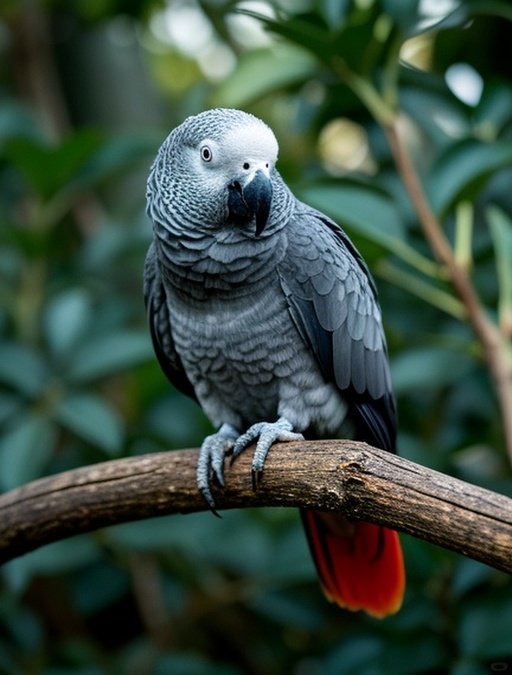
Okay, so picture this: you're in the kitchen, trying to have a private phone conversation. Suddenly, from the living room, you hear a perfect imitation of your own voice saying, 'Honey, where are my keys?' You rush in, only to find your African Grey, perched calmly, looking at you with those wise, knowing eyes. That's Einstein, my first Grey. He didn't just mimic sounds; he understood context. One time, my husband sneezed, and Einstein immediately chimed in with 'Bless you!' We were floored. It's these moments that make you realize you're not dealing with a simple bird; you're living with a tiny, feathered comedian who's always studying you.
Their intelligence is mind-blowing. My current Grey, Pixel, has a toy box. She doesn't just play with toys randomly. She has favorites, and she'll actually go and pick out the specific colored ring or bell she wants. If she drops it, she looks at me, then at the toy, then back at me, clearly expecting me to fetch it. The roles are reversed, I tell ya! Training them is a two-way street. They learn tricks super fast—wave, turn around, fetch a tiny ball—but they also train *us*. Pixel knows that making a certain clicking sound means she wants a walnut. And you better believe we jump to get it, because the alternative is her giving us the serious side-eye from her cage.
But here's the thing, their smarts come with big feelings. African Greys are sensitive souls. They form incredibly deep bonds. If you have a bad day and are quiet, they'll be quiet too, just watching you. Or they might softly whistle a tune you often hum to cheer you up. They pick up on the mood of the house instantly. I've seen Pixel get genuinely sulky if my attention is on my laptop for too long. She'll start preening loudly or deliberately drop a toy, like a toddler saying, 'Hey, look at me!' You can't just leave them with food and water; they need your time, your conversation, your friendship. It's a commitment, but the rewards are endless laughs and a unique companionship.
Their talking ability is legendary, but it's the unexpected phrases that crack you up. Einstein once perfectly mimicked the sound of our microwave beeping. For weeks, we'd jump up thinking dinner was ready, only to find him looking terribly pleased with himself. Pixel has mastered the sound of our dog's squeaky toy. The poor dog gets so confused, running around looking for a toy that isn't there. And it's not just imitation; they associate words. When the doorbell rings in a movie, Pixel often says 'Hello!' She's connected the sound to greeting someone. It shows they're not just parroting sounds (pun intended!); they're making connections in their clever little heads.
Caring for an African Grey isn't all fun and games, though. They're messy eaters—prepare for food flung far and wide. They need a varied diet of pellets, fresh veggies, nuts, and some fruit. And mental stimulation is key. A bored Grey is a destructive Grey. They might start plucking their feathers if they're unhappy or under-stimulated. So, you need to be their full-time entertainer: new toys, foraging puzzles, training sessions, and lots of out-of-cage time to explore (under supervision, of course—they love to chew on woodwork!). It's a big responsibility, but seeing them happy, healthy, and engaged is worth every minute.
In the end, living with an African Grey Parrot is like having a perpetual, feathery three-year-old with the vocabulary of a professor and the comedic timing of a stand-up star. They'll surprise you, challenge you, and love you in their own unique way. They're not for everyone—they need a dedicated owner who understands their complex needs—but if you're ready for the adventure, they'll fill your home with more laughter, conversation, and love than you ever thought possible. Just remember, with a Grey, you're always on stage, and they are the keenest audience—and sometimes, the star performer.